DIY Starter Motor Test: No-Crank Diagnosis Steps
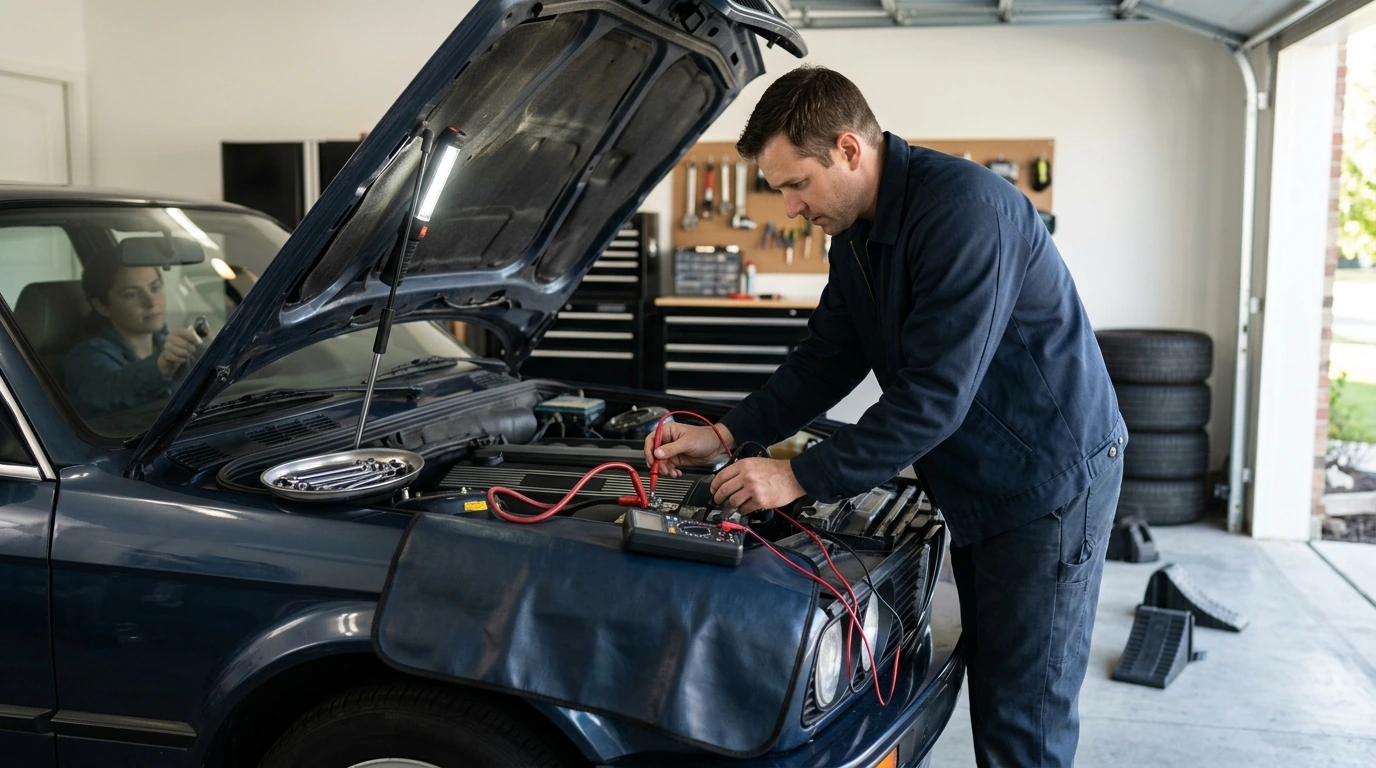
Checking Your Car’s Starter Motor: A DIY Diagnostic and Troubleshooting Guide
A weak or failing starter motor can mimic battery, cable, or ignition-switch problems. A structured check—starting with simple visual inspections and ending with voltage-drop testing—helps pinpoint what’s actually wrong, so you fix the right part the first time.
What the Starter Motor Does (and What It Doesn’t)
The starter motor’s job is simple: it spins the engine fast enough to begin running on its own. It does this by engaging the flywheel (manual) or flexplate (automatic) through the starter drive (often called the Bendix).
The starter solenoid is closely tied to this process. It acts like a heavy-duty electrical switch that routes high current to the starter motor, and it also pushes the pinion gear into the flywheel/flexplate teeth.
Where things get confusing: a “no-crank” complaint isn’t always a starter problem. Low battery state-of-charge, corroded terminals, poor engine grounds, a bad neutral safety/clutch switch, a worn ignition switch, immobilizer issues, or even a seized engine can all prevent cranking. Symptom patterns help narrow it down: a single click, rapid clicking, a slow crank, or an intermittent no-crank each point in different directions.
Safety and Tools for Quick, Confident Checks
Basic safety setup
Set the parking brake, chock wheels, and confirm the transmission is in Park/Neutral (or clutch depressed on manuals). Keep hands, hair, and clothing clear of belts and fans. If you must work underneath, use proper jack stands—never rely on a jack alone.
Battery precautions
Remove jewelry, avoid bridging battery terminals with tools, and work in a ventilated area. If a battery is swollen, leaking, or smells strongly of sulfur, stop and replace it.
Tools you’ll actually use
- Digital multimeter (DMM)
- Basic hand tools and a flashlight
- Wire brush/battery terminal cleaner
- A helper for key-turn tests
- Optional: jump pack/charger; OBD-II scan tool for related codes
Fast Triage: What Happens When the Key Turns?
- No sound at all: Think power distribution or control signal—battery connections, main fuses, starter relay, ignition switch signal, neutral safety/clutch switch, or immobilizer behavior.
- Single loud click: The solenoid may be engaging but the motor isn’t spinning. This can still be a weak battery, high resistance in cables/grounds, or internal starter wear.
- Rapid clicking: Commonly low voltage under load (battery weak) or poor terminal contact.
- Slow crank: Weak battery, high-resistance cables/grounds, failing starter, thick oil, or mechanical drag.
- Intermittent no-crank: Heat soak, worn brushes/commutator, loose connections, or relay issues.
Step-by-Step Starter Circuit Checks (No Parts Swapping)
1) Visual inspection (it’s faster than you think)
Confirm battery terminals are clean and tight. Look for green/white corrosion at the terminals and where ground straps bolt to the body/engine. Inspect the starter’s wiring for looseness, oil saturation, or heat damage near the exhaust.
2) Battery resting voltage (engine off)
3) Battery voltage during a crank attempt
4) Confirm the starter relay is being commanded
5) Check the solenoid trigger signal (small wire)
6) Check constant power at the starter (large terminal)
Voltage Drop Testing: Find Resistance Where It Hides
Continuity checks can miss the real problem: a connection that “technically connects” but can’t carry starter-level current. Voltage drop testing reveals resistance under load. For a deeper explainer, see AA1Car’s voltage drop testing guide.
Positive side voltage drop
Ground side voltage drop
| Test | How to Measure | Typical Outcome | What It Points To |
|---|---|---|---|
| Battery resting voltage | Across battery posts, engine off | Around 12.4–12.7 V | Low reading suggests discharged/aged battery |
| Battery cranking voltage | Across battery posts while attempting to crank | Stays above ~9.6 V (varies by temp/vehicle) | Big drop suggests weak battery or high draw |
| Positive cable voltage drop | Battery + post to starter B+ terminal while cranking | Low drop | High drop indicates resistance in positive cable/connections |
| Ground path voltage drop | Starter case to battery – post while cranking | Low drop | High drop indicates poor ground strap/ground connections |
| Solenoid trigger voltage | Control terminal to ground during START | Near battery voltage | Low/no voltage indicates upstream control issue |
When the Starter Is the Likely Culprit
Troubleshooting Scenarios (Quick Decision Paths)
Using a Structured DIY Routine (and Helpful Digital Guides)
If you want a guided workflow you can follow in the driveway, the Checking Your Car’s Starter Motor eBook lays out a practical diagnostic sequence and troubleshooting flow so you can avoid replacing parts that aren’t failing.
For DIYers who use a phone/tablet for diagrams and meter references in the garage, Preventing and Relieving Screen-Induced Eye Strain – Practical eBook Guide can help you stay comfortable during longer troubleshooting sessions.
Also, if a starting issue appears suddenly, it’s worth checking for open safety actions and recalls through NHTSA’s recall lookup.
FAQ
Can a bad battery look like a bad starter motor?
Yes—both can cause slow cranking, clicking, or intermittent no-crank. A cranking-voltage test (and clean, tight terminals) helps separate low battery voltage from starter or cable resistance under load.
What does a single click when turning the key usually mean?
Often the solenoid is engaging but the starter motor isn’t spinning, which can be caused by low available current or high resistance in cables/grounds. Voltage drop testing during a crank attempt is one of the quickest ways to narrow it down.
Is it safe to test the starter solenoid trigger wire with a multimeter?
It can be safe if the vehicle is secured in Park/Neutral with the parking brake set and you keep clear of moving parts. Back-probe carefully (avoid shorting terminals), and stop if access is cramped or you can’t safely control the test setup.
















Leave a comment